Have you ever seen those little round robot vacuum cleaners that move back and forth across the floor like a hockey puck in slow motion? Years ago, I owned one, and it wasn’t anything to write home about. It would move across the floor in random patterns—more novelty than vacuum. Soon, it started collecting more dust sitting in a closet than it did when operating.
Today, many of those little vacuum cleaners are way more powerful, and are even using artificial intelligence (“AI”). I saw one on Amazon for sale earlier this year, read the reviews, and decided to give it another shot. I bought one and wow! I can’t begin to tell you how amazing it is! It uses AI technology to map the house, avoid obstacles, and adjust power/sweep/mopping settings when needed. Everything from popcorn kernels left by our kids, to cat hair, to the dirt I seem to inevitably track in—it sweeps it all up! I can set it to run on a schedule, run on demand, and can even pick and choose what rooms to focus on.
We are all starting to see AI in more and more parts of our lives, and I love reading about it all. I’m a technologist at heart, and a big nerd when it comes to all things tech. So, naturally, after the huge impact our robot vacuum had on our household floors, I started thinking about how else I could use AI to help me in my personal life.
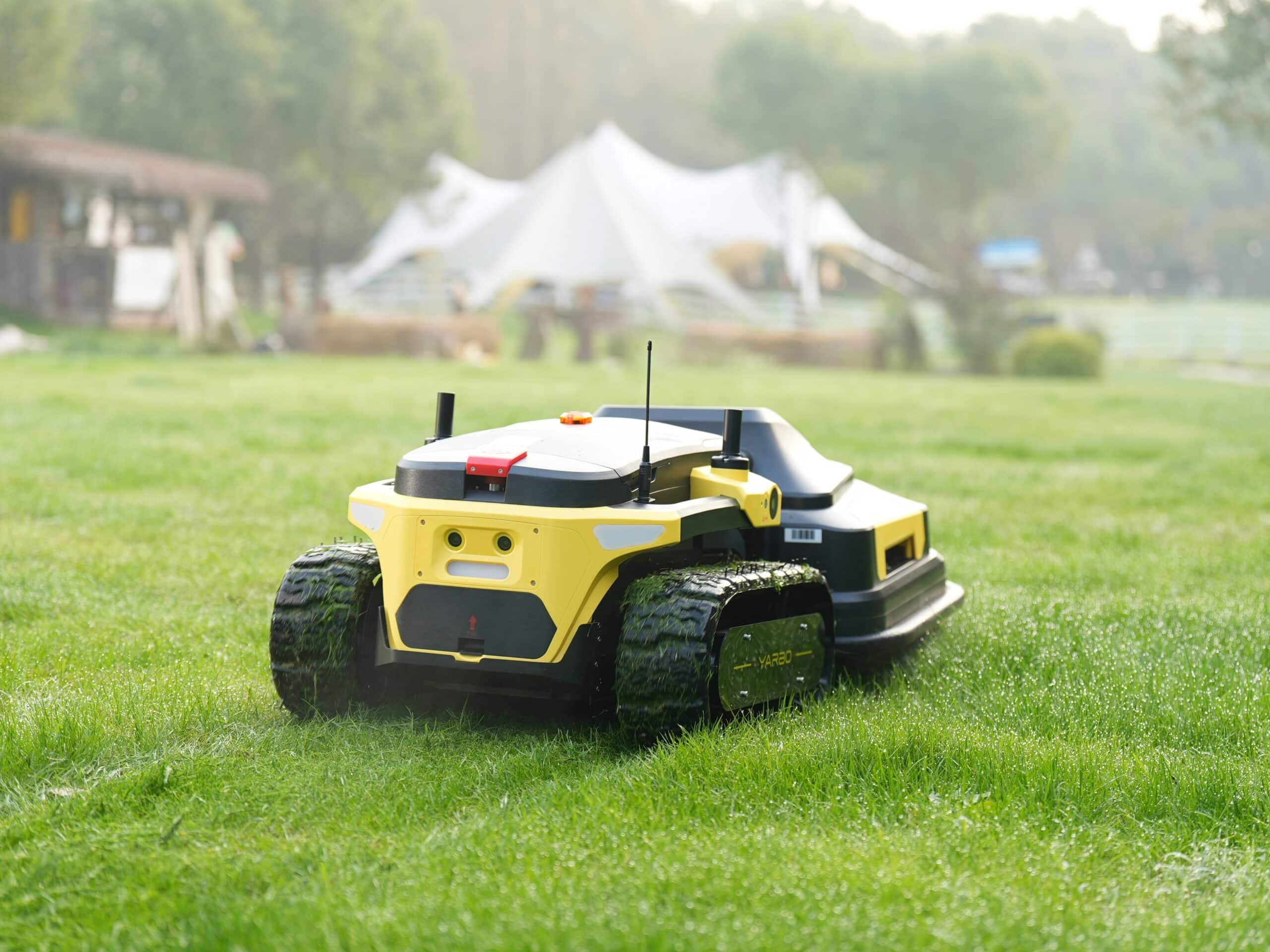
One day, I was flipping through social media and an ad popped up for a robot mower. It caught my attention and I clicked the link to learn more. The mower, like my vacuum, also leveraged AI in a similar way to map yards and mow whenever I wanted it to. “Here’s something else I could automate!” I thought. It sounded super cool and could be quite the time saver.
At first, I got excited about the potential of freeing up more time and even started planning how I could save up enough money to buy one, which would eventually require me selling my current mower. But then, something made me pause.
What would giving up mowing mean? True, I would be getting more time back, but I would also be losing some things.
You see. . . mowing is something my son and I have done together for the past couple of years now. Not only do we both get a sense of accomplishment from it, but it’s also teaching him responsibility and life skills. Giving up mowing would mean taking that away along with giving up things like exercise, vitamin D, and time to listen to audiobooks.
How many chances do we get to regularly make time for these activities? I work out in the mornings, sure, but my gym membership doesn’t come with complimentary vitamin D. And the life skills my son is learning from mowing are irreplaceable.
These all hold value and meaning to me, and to my son. And at the root of it all, what we take away from mowing culminates into an activity that gives us both a sense of purpose. And. . . did I really want to give up a piece of my purpose, no matter how small?
Don’t get me wrong. I’m a big proponent of using emerging technologies and AI as tools. In fact, it’s a big part of my career. The key—I found—the secret to using any technology, including AI, is using it responsibly and mindfully. And this was my chance to do just that. However, when it comes to potentially affecting my purpose, I need to reflect on it a bit.
The importance of purpose is not talked about enough. In fact, did you know that there is research that shows purpose is a stronger predictor of longevity than regular exercise? That study comes from researchers out of the University of Michigan. The researchers followed nearly 7,000 adults over the age of 50 for a few years. The people who reported having a strong sense of purpose were significantly less likely to die during that period—even when accounting for other factors like age, income, education, and health.
That’s wild! Think about it. Knowing why you get out of bed might matter as much if not more than that morning run. But to emphasize, exercise is still super important for our physical and mental health and longevity, and can even build a sense of purpose in and of itself.
It’s not just this study that links purpose to longevity. In Okinawa, Japan—one of the world’s “Blue Zones” where people live extraordinarily long and healthy lives—residents talk about “ikigai,” a kind of personal mission or reason for being. It’s not about job titles or social status. It’s about meaning. Something worth waking up for. And it’s what many of the centenarians attribute as the reason for their longevity.
I first learned about ikigai from a book by Francesc Miralles and Hector Garcia called Ikigai: The Japanese Secret to a Long and Happy Life. The book goes into details about how Okinawa has a high concentration of individuals who live past the age of 100 compared to the rest of the world. What is different? Garcia and Miralles suggest that ikigai, purpose, and mindful living may play big parts. “When you feel down, just thinking about your ikigai will change something in you,” says Garcia.
And for the Okinawans, ikigai is about more than just an individual’s purpose. It expands to social connections with others in the community. Garcia explains, “Avoiding social isolation is linked to the motivation and confidence to lead active lives.”
And so, the robot mower ad helped me discover something about myself. It showed me a piece of my ikigai, and I wasn’t about to give that up. I decided against the idea of buying a robot mower. That may sound like a small decision, but it was one made with the intention to always put purpose—my ikigai—before convenience.
That day I came away with more than just keeping the money in my pocket. The robot taught me a valuable life lesson—a lesson I will always carry. When deciding whether to use a new technology or AI, I will continue to ask questions like:
“What would I be giving up?”
“Does this further isolate me from human connection?”
“How does this affect my ikigai?”
AI is here to stay, and it is becoming evermore prevalent in day to day life. In another year or two, it will be in most consumer electronics. There will be more eye-catching ads curated for us based on algorithms, and we will be presented with new technologies that may sound like the answer to our prayers. And advancements in generative and agentic AI will continue enabling chatbots to say anything to please us. But AI is never a substitute for the human connection we all require.
But, we should always keep in mind that sometimes technology and AI can come with costs not found on the price tag. If we are not mindful, they can cost us things we enjoy, pieces of our ikigai, and ultimately pieces of ourselves. And when we lose our purpose or ikigai, we lose ourselves.
So remember, please use these new and emerging technologies, including AI, responsibly and mindfully. And I would encourage you to ask yourself: “How will this affect my ikigai?”
References
-
Gordon, M. (May 25, 2019). What’s Your Purpose? Finding A Sense of Meaning in Life Is Linked to Health. Retrieved from: https://www.npr.org/sections/health-shots/2019/05/25/726695968/whats-your-purpose-finding-a-sense-of-meaning-in-life-is-linked-to-health
-
Pearce, C., Alimujiang, A., Wiensch, A., Boss, J., Fleischer, N. L., Mondul, A. M., McLean, K., Mukherjee, B., Pearce, C. L. (May 24, 2019). Association Between Life Purpose and Mortality Among US Adults Older Than 50 Years. Retrieved from: https://jamanetwork.com/journals/jamanetworkopen/fullarticle/2734064?utm_source=For_The_Media&utm_medium=referral&utm_campaign=ftm_links&utm_term=052419
-
The Government of Japan. (March 18, 2022). Ikigai: The Japanese Secret to a Joyful Life. Retrieved from: https://www.japan.go.jp/kizuna/2022/03/ikigai_japanese_secret_to_a_joyful_life.html
-
García, H., & Miralles, F. (2017). Ikigai: The Japanese Secret to a Long and Happy Life. Penguin Life.